

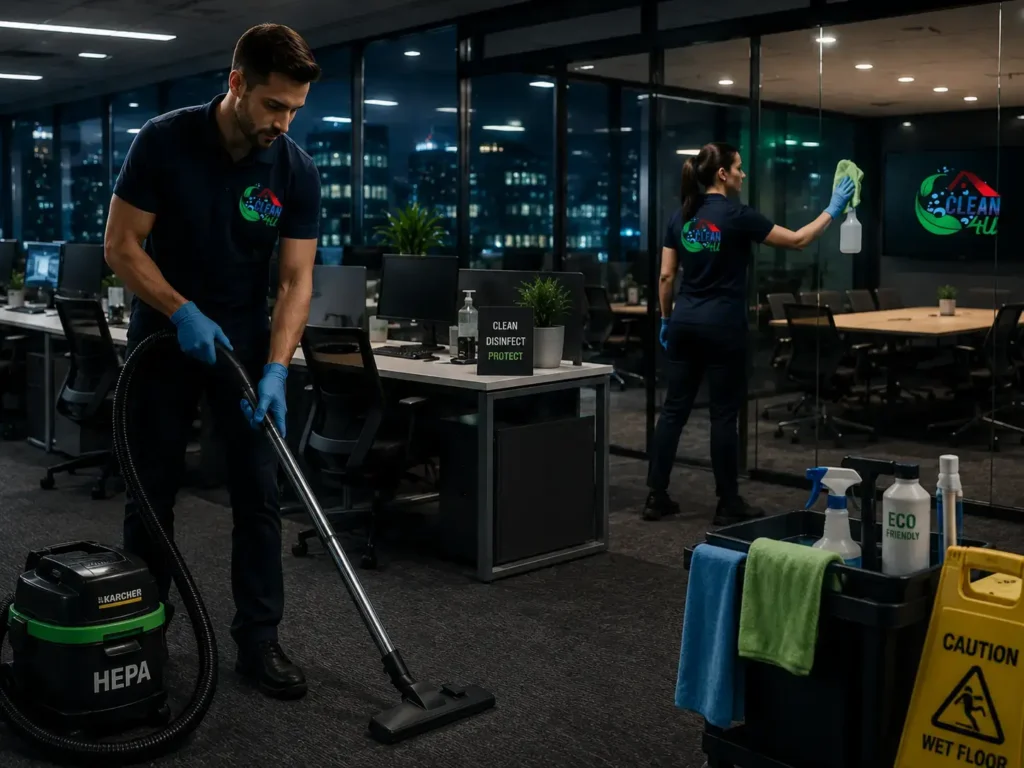
An office can look presentable at the reception area and still fail the people who spend forty hours a week inside it. Emptied bins and hoovered carpet tell you very little about the scope of hygiene at desk level. A capable commercial office cleaning service plans for the whole building, because the areas nobody inspects are usually the areas causing problems.
The gap shows up in sickness absence, stale meeting rooms, and a canteen that staff quietly avoid. A structured commercial office cleaning service closes that gap with a written plan covering every zone, from keyboards to washroom floors, on a frequency that matches how each space is used. The rest of this article sets out what that plan needs to cover.
Where a Basic Vacuum and Bins Routine Falls Short
Surface Shine That Hides Desk-Level Contamination: A standard office clean that stops at floors and bins leaves the surfaces people actually touch largely untreated. Desks, shared phones, door handles, lift buttons, and kettle handles pass between dozens of hands each day. Wiping them with the same cloth used elsewhere simply moves soil around instead of removing it, so contamination builds week after week.
Small Lapses That Grow Into Larger Repairs: Postponing a proper plan narrows your options over time. Grease sets into canteen extract surfaces, limescale hardens in washrooms, and carpet fibres grind flat under trapped grit until replacement becomes the only fix. In everyday facilities work, supervisors routinely see offices where poor occupational hygiene was tolerated for years and the eventual deep clean cost far more than steady maintenance would have.
Every Zone in the Office Carries Its Own Cleaning Demands
Desks and High-Touch Points Need Daily Attention: High-touch points need sanitising daily because they recontaminate within hours of use. Desks, keyboards, mice, phone handsets, handles, switches, and shared printers should be on the daily list, cleaned with colour-coded microfibre so clothes from washrooms never reach a workstation. That separation is the difference between genuine hygiene and the appearance of it.
Kitchens, Canteens, and Washrooms Set the Hygiene Standard: Kitchens, canteens, and washrooms carry the highest bacterial load in any office and need food-safe and sanitary-grade treatment every working day. Fridge interiors, microwave splatter, sink traps, taps, cubicle fittings, and floors each need their own products and dwell times. Consumables such as soap, paper, and bin liners belong in the plan as well, restocked before they run out.
Carpets, Hard Floors, and IT Areas Follow Their Own Cycles: Floor care works on a cycle rather than a single task. Carpets need daily vacuuming with HEPA filtration and periodic extraction cleaning, while hard floors need the right pads and finishes to avoid dulling. Server rooms and IT areas need anti-static, low-moisture methods, because dust build-up around equipment shortens hardware life and ordinary wet cleaning risks damage.
Matching Methods and Equipment to Each Area
Different Soils Respond to Different Chemistry: Each zone accumulates a different type of soil, and the chemistry has to match it. Degreasers handle canteen surfaces, descalers deal with washroom limescale, and neutral cleaners protect sealed floors. Products low in volatile organic compounds matter in enclosed offices, because harsh formulations linger in the air long after the cleaner has left and staff notice the difference.
Equipment Choices That Prevent Cross-Contamination: The right kit does as much work as the right products. Steam units sanitise washroom fittings without heavy chemical use, HEPA vacuums capture fine dust and allergens rather than recirculating them, and separate colour-coded systems keep kitchen and sanitary tools apart. An office cleaned with one mop and one bucket is being redecorated with its own bacteria.
A Workspace-Specific Schedule Beats a One-Size Contract
Generic Contracts Leave Predictable Gaps: A generic contract applies the same routine to every building and misses what makes yours different. In-house cleaning gives control but pulls staff from their real jobs and rarely covers specialist floor or IT work. A planned commercial office cleaning service sits between the two, bringing trained people and proper equipment without adding headcount, though it does require a good briefing to work well.
An On-Site Audit Turns a Quote Into a Schedule: A workspace-specific schedule starts with an on-site audit rather than a price list. A walkthrough records floor types, occupancy patterns, high-traffic routes, canteen use, and any sensitive areas, then assigns each zone a task, a method, and a frequency. The result is a written schedule your team can check, adjust, and hold the provider to.
A Planned Clean Protects the Building and the Budget
Maintained Assets Outlast Neglected Ones: Planned cleaning preserves the fabric of the building itself. Carpets protected from ground-in grit last years longer, sealed floors keep their finish, and washroom fittings escape permanent scale damage. Spread across a lease, a consistent commercial office cleaning service costs a fraction of early refurbishment, which makes it an asset-protection decision as much as a hygiene one.
A Cleaner Office Supports the People in It: The everyday payoff lands on your staff. Lower dust levels mean fewer allergy complaints and less strain on ventilation, tidy shared spaces reduce friction between teams, and a fresh canteen gets used instead of avoided. Clients read the same signals, because a well-kept office quietly tells visitors the business looks after details before they become problems.
What a Complete Office Cleaning Plan Should Include
Points Your Written Plan Must Cover: Before signing with any commercial office cleaning service, check that the written plan covers every point below. These are the items that separate a schedule built for your building from a template pulled off a shelf, and a plan that skips even one of them tends to show its gaps within the first month of the contract.
- Daily sanitising of desks, door handles, switches, and other shared touch points.
- Food-safe treatment of kitchens and canteens, including fridges, microwaves, and sinks.
- Washroom hygiene with descaling, sanitary disposal, and consumables restocked on schedule.
- Scheduled carpet extraction and hard-floor maintenance alongside daily vacuuming.
- Low-moisture, anti-static care for server rooms and IT equipment areas.
- A named frequency for every task, agreed after an on-site audit and reviewed regularly.
A Workspace That Works as Hard as Your Team
A properly planned clean gives you a healthier office, longer-lasting fittings, and one less thing to manage. Every month spent on a bins-and-hoover routine lets grime, scale, and wear move further beyond easy correction. Book an on-site audit today and get a workspace-specific schedule with a clear fixed quote for your building.
