

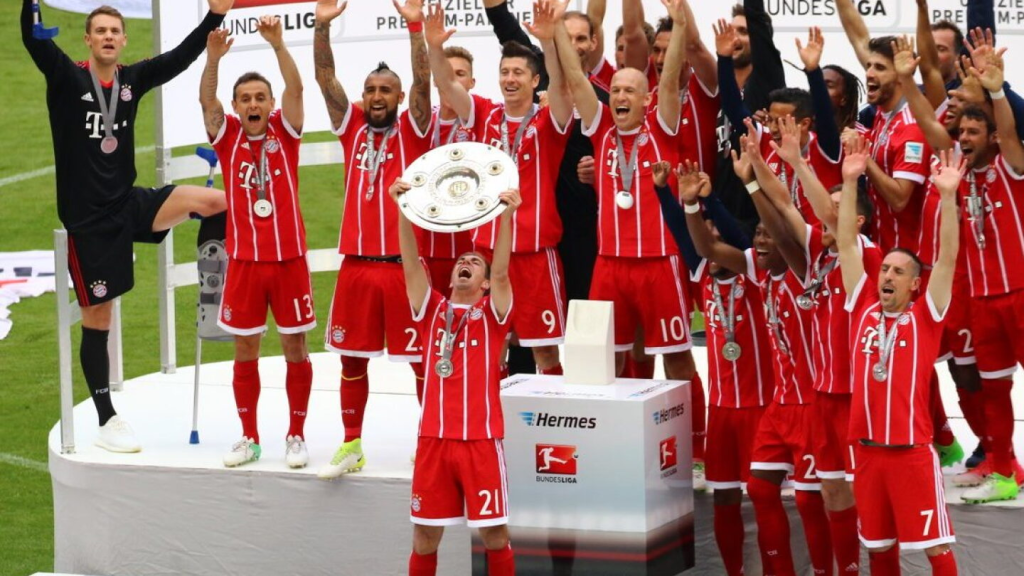
Late goals were a recurring feature of the 2016–17 Bundesliga, with several clubs repeatedly changing games in the final 15 minutes rather than in controlled first‑half patterns. For live bettors, those teams turned the 75th minute onward into a distinct phase of opportunity, where understanding who stayed dangerous until the end mattered more than the scoreline alone.
Why Focusing on the Final 15 Minutes Is Reasonable
Across major leagues, analytics sites track goals by 15‑minute segments and consistently show that scoring frequency tends to rise late in matches as fatigue, desperation and tactical risk increase. The Bundesliga fits that pattern, with “late goals” statistics specifically measuring how many times teams score or concede from the 75th minute to full‑time, highlighting that a non‑trivial share of totals and comebacks arrive in this window. The cause–effect relationship for betting is direct: if you know which 2016–17‑type teams regularly kept attacking and scored late, and which collapsed defensively, you can treat the last quarter‑hour as a structured market rather than a coin‑flip.
How Late Goals Typically Arise in Bundesliga Matches
Late goals rarely come from nowhere; they emerge from evolving game states. As matches move past 75 minutes, trailing teams typically push more players forward, while leading sides decide between protecting the box or continuing to attack, often leaving space either way. Live‑betting strategy articles emphasise that in this phase, cumulative pressure—shots, corners, territorial dominance—translates into higher probabilities of a late goal than raw pre‑match odds imply, especially when one team has been clearly on top. In a 2016–17 context, games where Bayern or Dortmund chased equalisers or expanded slender leads frequently produced goals in this window, not because of “luck,” but because their attacking quality and depth intersected with tired defences.
Bayern and Leipzig: A Case Study in Dramatic Late Swings
One of the clearest examples of late‑goal potential in 2016–17 was Bayern’s 5–4 win away to RB Leipzig on Matchday 33. Bayern trailed 4–2 with six minutes of normal time remaining yet scored three times between the 84th minute and stoppage time to win 5–4, demonstrating their capacity to sustain attacking threat deep into matches and to punish any drop in opponent structure. The live ticker from that game highlights how pressure built: Bayern continued to create chances despite the scoreline, and once Leipzig tired and space opened, the favourite’s technical superiority turned sustained pressure into late goals in quick succession.
For bettors, the impact is twofold. First, matches involving strong, possession‑heavy sides like that Bayern team cannot be treated as “decided” at 75 minutes, even when they trail. Second, when a team with Leipzig’s intensity has to defend deep late on after expending energy pressing earlier, the probability of conceding grows—creating late‑goal opportunities both for and against them in live markets.
Interpreting Late-Goal Stats Tables for 2016–17 Profiles
Dedicated “late goals” tables, which aggregate goals scored and conceded from the 75th minute onwards, offer a compact way to spot teams with consistent late‑match behaviours. Although many current tables cover recent seasons, the structure they use—counting late goals, late concessions and streaks—can be applied back to 2016–17 through archived data and match reports, revealing patterns like:
- Big clubs with deep benches scoring above‑average numbers of late goals as fresh attackers enter tired games.
- Smaller or high‑energy teams conceding disproportionately in the final 15 minutes as physical and mental fatigue sets in.
By mapping 2016–17 teams onto those archetypes, you can focus live‑betting attention on fixtures where one side’s late‑goal profile is significantly skewed. For example, a team that repeatedly turned draws into wins in the last quarter‑hour is a stronger candidate for “next goal” or “over 0.5 late goals” than a side whose scoring was front‑loaded and whose substitutions rarely improved attacking output.
Mechanism: Late Goals, Momentum and Live Odds
Live‑betting guides stress that odds shift continuously as time passes and scores remain unchanged, often drifting towards unders as the clock winds down. However, when in‑play stats show sustained attacking pressure—shots on target, corners, territorial dominance—combined with a historical tendency for late goals, the true probability of a final‑phase goal can be higher than what the generic time‑decay in odds suggests. In a 2016–17‑type Bundesliga match, that might mean:
- A strong side is level or narrowly behind at 75 minutes but has dominated shots and possession.
- Live odds on “over 0.5 additional goals” or “home/away to score next” have lengthened mainly because of time elapsed.
- If that side’s 2016–17 profile included frequent late goals, you have both process and history arguing that a strike in the last 15 minutes remains likely.
The edge arises when markets treat time as the primary driver but underweight team‑specific late‑goal behaviour.
Using UFABET to Systematically Exploit Late-Goal Tendencies
When you want to turn these patterns into a repeatable approach, the way you use your betting environment matters. For a bettor working through ยูฟ่า168, a disciplined method is to filter and tag each live bet placed after the 75th minute according to:
- Whether the chosen team has a history of late scoring or conceding in a 2016–17‑style profile.
- Whether in‑play stats (shots, corners, possession) currently support the case for an additional goal.
By periodically reviewing that UFABET bet history, you can see whether late‑goal filters actually improve results—perhaps noticing that bets placed only when both historical tendency and live pressure align perform better than those taken on narrative alone. Over time, this transforms the last 15 minutes from a place where emotion drives action into a phase governed by data‑backed triggers.
How Late-Goal Teams Contrast with casino online Dynamics
Late‑goal analysis leverages the fact that football matches evolve: fatigue, substitutions and score pressure change both behaviour and probabilities between the 75th and 90th minute. In a casino online context, by contrast, each spin or hand carries fixed odds and is unaffected by “late pressure” or “momentum,” making the idea of a “strong final 15 minutes” meaningless. For bettors moving between in‑play football markets and a casino online website, keeping this difference in mind prevents a common bias: assuming that timing skill in live matches—waiting for pressure plus price—translates into an edge in games deliberately insulated from such patterns.
Practical Late-Goal Filters Borrowed from 2016–17 Behaviour
To operationalise the idea of “late‑goal teams” from a season like 2016–17, you can use a simple multi‑step filter before considering any bet in the last 15 minutes:
- Historical tendency: Does at least one team have a documented pattern of scoring or conceding above the league average from the 75th minute onward in league‑wide late‑goal tables?
- Current game state: Is the scoreline creating real incentive for risk—drawn or one‑goal margins—rather than a settled, low‑stakes outcome?
- In‑play pressure: Do live stats show continued attacking intent—shots on target, high possession in the final third, frequent corners?
- Squad depth and substitutions: Has the stronger side introduced fresh attackers, or is the weaker side tiring without equivalent reinforcement?
When most of these boxes are ticked, the last 15 minutes resemble many of the dramatic 2016–17 moments, including Bayern’s late turnaround in Leipzig, where sustained pressure and quality trumped the clock. When they are not—say, both teams are content with the result or the game has become disjointed—the odds on a late goal may be long for good reason, and restraint becomes the rational choice.
Summary
In the 2016–17 Bundesliga, late goals were not random shocks but recurring products of team quality, depth, fatigue and game state, with sides like Bayern and other dominant clubs repeatedly altering matches in the final 15 minutes when chasing or enlarging results. For live bettors, recognising which teams sustained pressure to the end, and combining that historical knowledge with in‑play data and structured filters, turns the closing phase from a purely emotional window into one where last‑minute bets can be driven by evidence rather than impulse.