

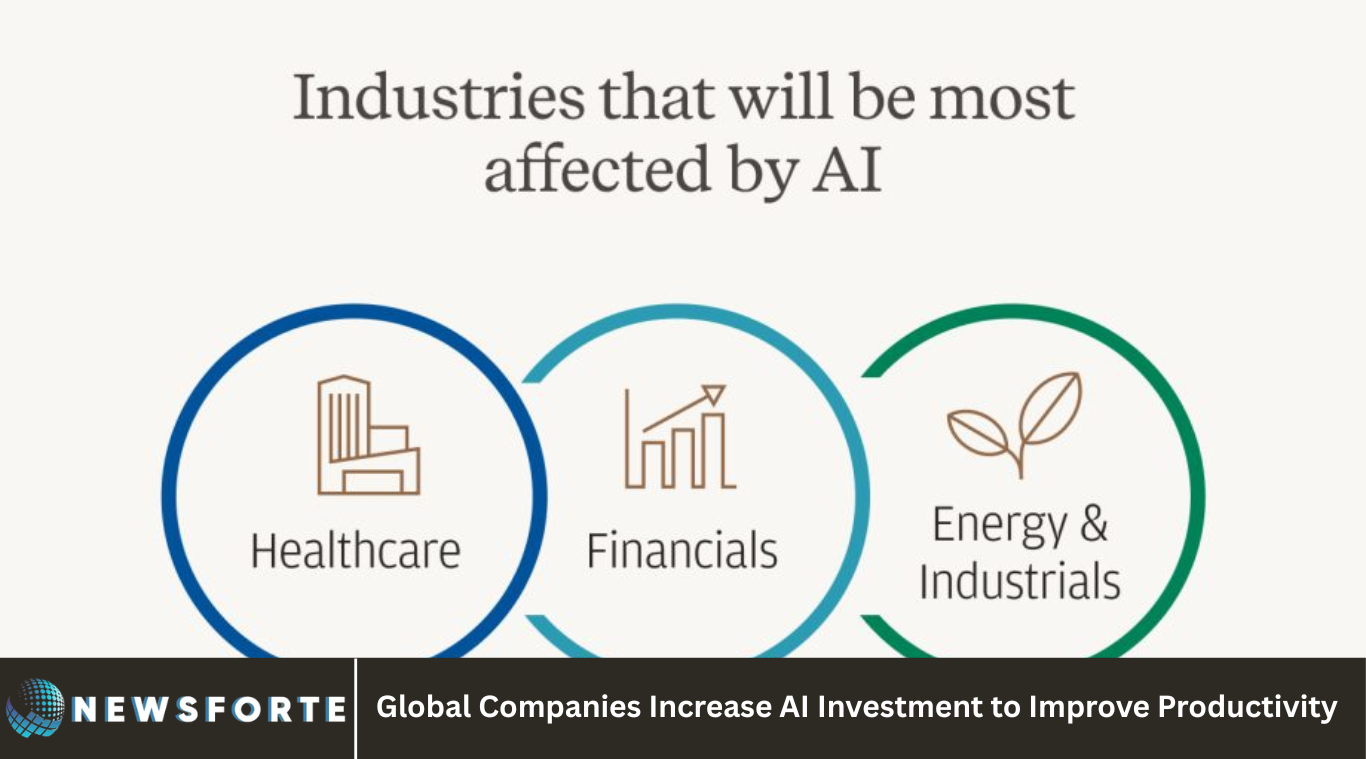
Artificial intelligence has become one of the most important technologies in the modern business world. Companies across different industries are investing heavily in AI to improve productivity, automate repetitive tasks, analyze information, and create better customer experiences. What was once viewed mainly as an experimental technology is now becoming part of everyday business operations.
As AI tools become more capable and accessible, companies are finding new ways to use them. From customer service and marketing to software development, finance, manufacturing, and logistics, artificial intelligence is changing how organizations operate. The growing investment also reflects a wider shift toward digital workplaces where employees and intelligent systems work together.
Why Companies Are Investing in AI
The main reason businesses are increasing AI investment is the potential to improve efficiency. Many organizations spend large amounts of time on repetitive tasks such as data entry, document processing, customer support, scheduling, and information analysis.
AI can automate or simplify some of these activities, allowing employees to spend more time on work that requires creativity, judgment, and human interaction.
Companies are also interested in AI because it can process large amounts of information quickly. This can help businesses identify patterns and make decisions based on data.
AI and Workplace Productivity
Productivity is a major priority for businesses because higher productivity can allow companies to produce more while using resources more efficiently.
AI tools can help employees draft documents, summarize information, organize data, generate ideas, and complete routine digital tasks.
Instead of replacing every part of a job, AI is increasingly being used as an assistant that helps workers complete tasks faster.
AI-Powered Business Automation
Automation is one of the most common uses of artificial intelligence.
Businesses can use AI to automate workflows involving emails, customer inquiries, reports, scheduling, data processing, and other routine activities.
Automation can reduce the amount of manual work employees need to perform.
However, companies need to carefully design automated workflows to ensure that errors do not spread across multiple systems.
AI in Customer Service
Customer service departments are increasingly using AI-powered tools to respond to common questions.
AI chatbots can provide information, guide customers through basic processes, and direct complicated requests to human representatives.
This can reduce waiting times and allow support teams to focus on more difficult customer problems.
The most effective systems combine AI automation with human support rather than attempting to eliminate human interaction completely.
AI in Marketing
Marketing teams are using AI to understand audiences, generate content ideas, analyze campaigns, and personalize customer communication.
AI can process large amounts of customer and market information and identify patterns that may be difficult to find manually.
This allows marketers to make faster decisions and experiment with different strategies.
Human creativity remains important because effective marketing requires understanding emotions, culture, branding, and customer expectations.
AI in Software Development
Software development is another area experiencing rapid AI adoption.
AI coding assistants can help developers generate code, explain functions, identify possible errors, and automate repetitive programming tasks.
This can reduce development time and help developers focus on architecture, testing, security, and complex problem-solving.
At the same time, generated code needs careful review because AI systems can produce incorrect or insecure solutions.
AI in Data Analysis
Businesses generate enormous amounts of data every day.
AI can help organizations process this information, identify trends, and create summaries that support decision-making.
Instead of manually reviewing large datasets, employees can use intelligent tools to quickly identify important patterns.
This can be particularly useful for sales, marketing, finance, supply chain management, and customer research.
AI in Finance
Financial departments can use AI for tasks such as analyzing transactions, forecasting, detecting unusual activity, and processing documents.
AI can help financial professionals identify patterns and reduce some forms of manual work.
Financial decisions still require human oversight because inaccurate data or incorrect assumptions can lead to serious consequences.
AI in Manufacturing
Manufacturing companies are also increasing their use of artificial intelligence.
AI systems can analyze equipment performance, identify potential maintenance issues, improve production processes, and monitor quality.
Predictive maintenance can help companies identify equipment problems before major failures occur.
This can reduce downtime and improve operational efficiency.
AI in Supply Chain Management
Global supply chains involve many interconnected processes.
AI can help companies analyze demand, manage inventory, optimize transportation, and identify potential disruptions.
Better forecasting can help businesses avoid having too much or too little inventory.
As supply chains become more complex, AI can provide valuable tools for managing large amounts of information.
AI in Logistics
Transportation and logistics companies can use AI to improve delivery planning and route optimization.
AI systems can analyze traffic conditions, delivery schedules, fuel consumption, and other factors to help identify efficient routes.
This can reduce delays and improve the use of vehicles and resources.
AI in Healthcare Businesses
Healthcare organizations are also exploring AI for administrative and analytical tasks.
AI can help process documents, organize information, support medical research, and analyze certain types of data.
Some healthcare applications can also assist professionals with analyzing medical images and identifying patterns.
Human expertise remains essential because healthcare decisions can have significant consequences.
AI in Retail
Retail companies are using AI to understand customer behavior, manage inventory, personalize recommendations, and improve customer support.
Recommendation systems can suggest products based on browsing or purchasing behavior.
AI can also help retailers forecast demand and reduce inventory problems.
This can improve both business efficiency and customer experiences.
AI in Human Resources
Human resources departments can use AI to organize applications, analyze workforce information, create job descriptions, and assist with employee support.
Automation can reduce administrative workloads and allow HR professionals to focus more on employee development and organizational planning.
However, companies need to be careful when using AI in hiring and employment decisions because automated systems can introduce unfair biases.
AI and Remote Work
The growth of remote and hybrid work has increased demand for digital productivity tools.
AI can assist remote workers by summarizing meetings, organizing documents, drafting communications, and managing information.
These tools can help distributed teams stay organized.
However, organizations should avoid using AI as a replacement for effective communication and collaboration between employees.
AI Agents and Business Workflows
AI agents are becoming an increasingly important part of business technology.
Unlike basic chatbots, AI agents are designed to complete multiple steps toward a specific objective.
For example, an AI agent could potentially gather information, analyze it, create a report, and organize the results.
As these systems become more reliable, they could automate larger portions of digital workflows.
AI and Employee Skills
The growth of AI is changing the skills employees need.
Workers may increasingly need to understand how to use AI tools effectively, evaluate AI-generated information, and provide appropriate instructions.
Critical thinking will remain important because employees need to determine whether AI-generated results are accurate and useful.
Communication, creativity, leadership, and problem-solving will also continue to be valuable.
AI Does Not Eliminate Every Job
There is significant discussion about whether AI will replace workers.
Some tasks may become automated, but jobs often contain many different responsibilities.
AI may automate certain activities while creating new roles and changing existing ones.
Companies are likely to need employees who understand both their professional fields and modern AI technologies.
Reducing Business Costs
AI can potentially reduce costs by automating repetitive processes and improving operational efficiency.
For example, automated customer support can handle common questions, while AI-powered analysis can reduce the time employees spend processing information.
However, AI implementation itself can be expensive.
Companies need to evaluate whether the expected productivity improvements justify the costs of software, infrastructure, training, and maintenance.
AI Investment Is Not Without Risks
Increasing AI spending comes with challenges.
Companies may face inaccurate AI outputs, cybersecurity risks, privacy concerns, regulatory requirements, and difficulties integrating AI with existing systems.
There is also a risk that organizations may invest in AI simply because it is popular without identifying a genuine business problem that the technology needs to solve.
Data Privacy and Security
AI systems often depend on large amounts of data.
Companies need to ensure that sensitive customer and employee information is handled responsibly.
Poor data protection could create privacy problems and expose businesses to security incidents.
Strong access controls, security policies, employee training, and careful vendor selection are important parts of responsible AI adoption.
The Importance of AI Governance
As AI becomes more important, businesses need clear policies for how it should be used.
AI governance can help organizations define acceptable uses, review risks, protect sensitive information, and establish responsibility for AI-assisted decisions.
Clear guidelines can also help employees understand when AI is appropriate and when human review is required.
Measuring AI Productivity Gains
Companies should measure whether AI investment is actually producing useful results.
Important indicators may include time saved, reduced operating costs, improved customer satisfaction, increased output, and better decision-making.
Simply deploying an AI tool does not guarantee higher productivity.
Businesses need to understand where the technology is creating measurable value.
The Role of Employee Training
Employees need proper training to use AI effectively.
Training can help workers understand how to write useful instructions, evaluate AI results, protect confidential information, and identify potential mistakes.
Companies that invest in employee education may be better positioned to gain long-term benefits from AI.
AI and Innovation
AI investment is not only about automation.
Businesses are also using artificial intelligence to develop new products and services.
Companies can use AI to identify customer needs, explore new ideas, simulate scenarios, and improve existing products.
This can create opportunities for innovation that were previously difficult or expensive to pursue.
The Future of AI Investment
AI investment is likely to remain an important business trend as organizations continue exploring practical applications.
Future systems may become more integrated into workplace software and business processes.
AI agents, automated workflows, intelligent analytics, and personalized business tools could become increasingly common.
The focus may gradually shift from simply adopting AI to using it effectively and responsibly.
What This Means for Businesses
Businesses that want to benefit from AI should focus on practical problems rather than adopting technology simply because it is popular.
The best opportunities may come from tasks that are repetitive, time-consuming, data-heavy, or difficult to scale manually.
Companies should begin with clear goals, measure results, protect data, and provide employees with appropriate training.
Frequently Asked Questions
Why are global companies investing more in AI?
Companies are investing in AI to improve productivity, automate repetitive tasks, reduce certain costs, analyze data faster, improve customer experiences, and develop new products and services.
How can AI improve employee productivity?
AI can help employees with tasks such as writing, research, data analysis, document processing, scheduling, customer support, and software development, allowing workers to focus more on complex responsibilities.
Will AI replace employees?
AI may automate some tasks, but it does not necessarily eliminate entire jobs. Many roles can change as employees use AI tools to complete certain activities more efficiently.
What are the risks of increasing AI investment?
Major risks include inaccurate AI results, privacy issues, cybersecurity threats, biased systems, high implementation costs, and poor integration with existing business processes.
What is the future of AI in business?
AI is expected to become increasingly integrated into business software and workflows. AI agents, automation, intelligent data analysis, and personalized tools may play a larger role in workplace productivity.
Conclusion
Global companies are increasing AI investment because artificial intelligence can improve productivity, automate repetitive tasks, analyze large amounts of information, and support innovation. AI is already influencing customer service, marketing, software development, finance, manufacturing, logistics, retail, and many other industries.